





1 GB / 7 days
Best for: A short visit with maps, messages and occasional browsing.
This option pairs the 1 GB allowance with a stated validity period of 7 days.
Usage tip: Save maps before longer journeys and use Wi-Fi for large downloads.
* The "as low as" figure is the lowest per-day rate, taken from the longest unlimited data plan on sale here.
Here's how Onetel stacks up against other options in Bangladesh.
Prices shown in USD
7 days of unlimited data in Bangladesh costs $35.58 — about $5.08 a day on Grameenphone, Robi Axiata or Banglalink, with no roaming charge and no SIM to swap. In Bangladesh, 5G is live and median mobile download speed is 27.8 Mbps.
Choose your Bangladesh eSIM by matching the allowance and validity period to your trip, then compare the selected product details with the local network, band and speed references already shown on this page.
Start with the length of your stay, then allow for navigation, messaging, streaming and work use. Each option below is a plan size that is currently available for this destination.
Best for: A short visit with maps, messages and occasional browsing.
This option pairs the 1 GB allowance with a stated validity period of 7 days.
Usage tip: Save maps before longer journeys and use Wi-Fi for large downloads.

Best for: A stay of around two weeks with regular navigation and messaging.
The 3 GB allowance remains available across a stated validity period of 15 days.
Usage tip: Keep automatic app updates and cloud backups on Wi-Fi.
Best for: A longer stay or more frequent streaming, video calls or work use.
The 10 GB or more / 30 days profile provides a larger data pool than the short-trip options on this page.
Usage tip: Compare the allowance with your normal phone usage and monitor it during the trip.
Your eSIM roams onto Bangladesh's own operators. These are the networks and the frequencies they run — check your phone supports them before you travel.
Source: Ookla Speedtest Global Index, July 2025
B1 (2100 MHz) is the primary 4G band nationwide; B8 (900 MHz) provides wider rural coverage. 5G launched in December 2021 and remains limited to parts of Dhaka and a few major cities. Teletalk's network is state-owned and has the smallest coverage footprint. No 2G/3G-only operators remain; all four operators run nationwide 4G.
The Bangladesh mobile network source is linked below as a public network reference. Check the places on your itinerary where the source offers local detail, then confirm the network information for the selected eSIM product. The operator table on this page provides the country-level reference, while the selected product details identify which network information applies to your plan.
Check your accommodation and the places you expect to visit in Bangladesh. Indoor reception can differ from an outdoor map, so keep the property Wi-Fi details available as well.
Review the full route rather than checking only the arrival city. Save tickets, addresses and maps offline before longer road or rail journeys.
Check the selected product scope for every country on your itinerary. Your Bangladesh plan and a regional plan may have different included destinations and validity periods.
Compare your phone with 4G bands B1, B3, B8 and 5G bands n78 in the existing Bangladesh network table. Support for more of the listed bands gives the phone more options when connecting, while the selected product, location and local network conditions determine the service available.
Keep the QR code and installation instructions available offline, and complete each step according to the selected product's instructions.
When validity starts: Validity-start rules can differ by product. Check the selected plan details before installation and travel.
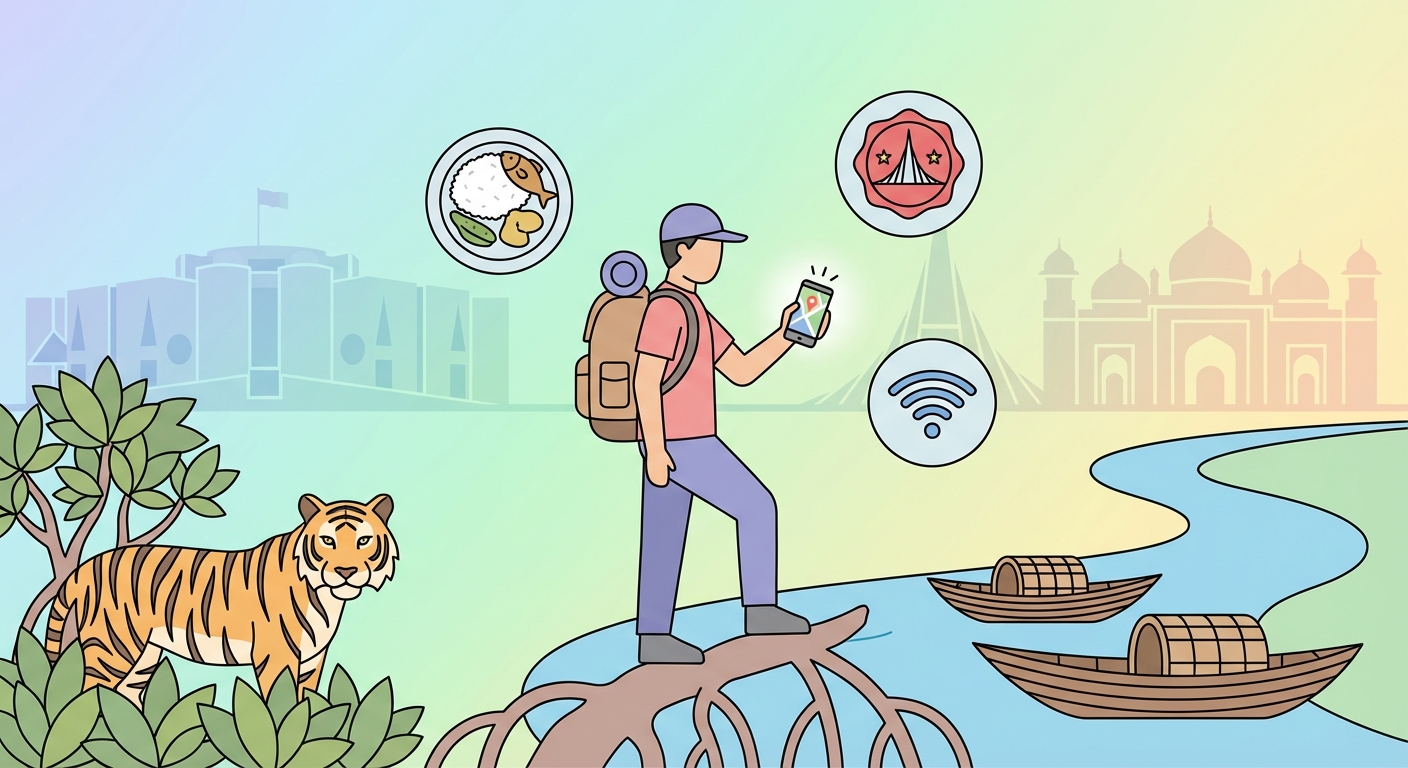
Bangladesh rewards travellers who slow down and engage with daily life. Start in Dhaka, where rickshaws crowd the streets and street food stalls sizzle from morning until late. A boat ride on the Buriganga River reveals a different pace. From the capital, head south to the Sundarbans, the world's largest mangrove forest. A guided boat tour here offers the best chance to see Bengal tigers, saltwater crocodiles, and spotted deer. For a quieter experience, explore the riverine villages of the Ganges delta by local ferry. Bangladeshi hospitality is genuine. Accept tea invitations from shopkeepers and homestay offers in rural areas. Learn a few Bengali phrases such as dhonnobad (thank you) and kemon achen (how are you). Respect local customs: remove shoes before entering homes and mosques, and dress modestly outside tourist areas. Travel between December and February for the most comfortable temperatures.
Sundarbans National Park - A UNESCO World Heritage Site and the last stronghold of the Bengal tiger. Only accessible by boat tour. Go between November and February for cooler weather and better wildlife sightings. Book through a registered tour operator from Khulna or Mongla.
Cox's Bazar Beach - The world's longest natural sea beach stretches over 120 kilometres. The main strip near the town is busy. For quieter sand, head south to Inani Beach or Himchari National Park. Rip currents are common; swim only where locals do.
Sixty Dome Mosque (Bagerhat) - One of the most impressive mosques in South Asia, built in the 15th century. Part of a larger UNESCO World Heritage Site called the Mosque City of Bagerhat. Visit early morning to avoid crowds.
Paharpur Buddhist Monastery - The largest Buddhist monastery south of the Himalayas. The red brick ruins date back to the 8th century. Combine with a visit to the nearby Somapura Mahavihara museum.
Ahsan Manzil Palace (Dhaka) - A restored pink palace from the Bengali Nawab era. Overlooks the Buriganga River. Allow two hours for the museum and gardens.
Biryani - Bangladeshi biryani is distinct from its Indian counterpart. It uses fragrant short-grain rice, tender meat (usually chicken or beef), and a generous dose of potatoes. Dhaka's old town has legendary stalls. Look for places with long queues of locals.
Hilsa Fish Curry - The national fish of Bangladesh. Hilsa is bony but prized for its delicate flavour. The most common preparation is shorshe ilish (cooked in mustard seed paste). Best eaten during the monsoon season (June to September) when the fish are at their fattest.
Pitha - Traditional rice cakes, especially popular in winter. Varieties include bhapa pitha (steamed with coconut and jaggery) and chitoi pitha (pan-fried). Street vendors in rural areas sell them fresh.
Bhuna Khichuri - A savoury rice and lentil dish cooked with spices. Eaten for breakfast or lunch on rainy days. Often served with fried eggs or beef.
Fuchka - Crisp hollow shells filled with spicy tamarind water, mashed potato, and chickpeas. A popular street snack. Only eat from stalls with high turnover to ensure freshness.
Bangladesh has a tropical monsoon climate with three main seasons. The cool, dry winter from November to February is the most comfortable period for travel. Daytime temperatures range from 20°C to 25°C. This is the ideal time to visit the Sundarbans and Cox's Bazar Beach. The pre-monsoon summer from March to May is hot and humid, with temperatures reaching 35°C. April and May are the hottest months. Travel during this period is possible but tiring. The monsoon season runs from June to October. Heavy rain floods low-lying areas and disrupts road travel. However, the landscape turns vividly green, and the rivers are full. October is a transition month. Rain eases but humidity remains high. The Sundarbans remain accessible, though some trails may be muddy. For wildlife viewing, the dry season is best because animals gather around shrinking water sources.
Lightweight, breathable clothing - Cotton and linen are your best choices. Long sleeves and trousers protect against mosquitoes and sun. Bangladesh's humidity makes synthetic fabrics uncomfortable.
Mosquito repellent - Essential for evenings and rural areas, especially near the Sundarbans. Choose a repellent containing DEET. A mosquito net is recommended for budget accommodation.
Sun protection - High SPF sunscreen, a wide-brimmed hat, and sunglasses. The tropical sun is intense even in winter.
Modest clothing for temple visits - Women should carry a scarf or shawl to cover shoulders and head. Men should wear long trousers. Remove shoes before entering mosques.
Water purification - Tap water is not safe to drink. Carry a reusable water bottle with a built-in filter or bring purification tablets. Bottled water is widely available in cities but scarce in remote areas.
The details worth knowing about your Bangladesh eSIM
Live chat and email are staffed the whole way through — before you fly and while you're abroad. Replies typically land in under 2 minutes.
Talk to us
Browse eSIM plans for more countries worldwide.