





🇪🇨 eSIM plans for Ecuador

Starting at $3.66/day*
  • No data caps
  • 7-days valid
  • Fast, reliable connection
  • Skip the roaming bill
  • QR code emailed instantly
Get your unlimited data
How many days
More days, lower daily rate
7
How many eSIMs
More eSIMs, bigger discount
1
Install it now or once you're away. Nothing starts counting until you reach your destination and switch the eSIM on.

* The "as low as" figure is the lowest per-day rate, taken from the longest unlimited data plan on sale here.

Secure Checkout
Visa Mastercard PayPal Amex Diners JCB
Ecuador eSIM travel illustration

Why buy from us?

Here's how Onetel stacks up against other options in Ecuador.

Onetel
Local SIM card
Roaming
Uncapped data plans
Activates instantly
Your number stays the same
No surprise charges
No lock-in
24/7 support
Latin America eSIM

Cover the Region with Latin America eSIM

Cover Ecuador and every neighboring country on one regional eSIM — no SIM swaps, no extra fees. Starting at $3.10.

View Latin America Plans
🇪🇨

eSIM costs for Ecuador

Prices shown in USD

7 days of unlimited data in Ecuador costs $29.02 — about $4.15 a day on Claro Ecuador, Movistar Ecuador or CNT, with no roaming charge and no SIM to swap. In Ecuador, 5G is live and median mobile download speed is 25.8 Mbps.

Duration Price Daily cost
1 day $7.56 $7.56/day
3 days $12.92 $4.31/day
5 days $18.30 $3.66/day
7 days $29.02 $4.15/day
10 days $55.86 $5.59/day
15 days $109.52 $7.30/day
30 days $270.52 $9.02/day
🇪🇨

Which Ecuador eSIM plan fits your trip?

Choose your Ecuador eSIM by matching the allowance and validity period to your trip, then compare the selected product details with the local network, band and speed references already shown on this page.

Start with the length of your stay, then allow for navigation, messaging, streaming and work use. Each option below is a plan size that is currently available for this destination.

Short trip

1 GB / 7 days

Best for: A short visit with maps, messages and occasional browsing.

This option pairs the 1 GB allowance with a stated validity period of 7 days.

Usage tip: Save maps before longer journeys and use Wi-Fi for large downloads.
Two-week trip

3 GB / 15 days

Best for: A stay of around two weeks with regular navigation and messaging.

The 3 GB allowance remains available across a stated validity period of 15 days.

Usage tip: Keep automatic app updates and cloud backups on Wi-Fi.

Longer or higher use

10 GB or more / 30 days

Best for: A longer stay or more frequent streaming, video calls or work use.

The 10 GB or more / 30 days profile provides a larger data pool than the short-trip options on this page.

Usage tip: Compare the allowance with your normal phone usage and monitor it during the trip.

🇪🇨

Which networks you connect to in Ecuador

Your eSIM roams onto Ecuador's own operators. These are the networks and the frequencies they run — check your phone supports them before you travel.

Operator 4G / LTE bands 5G bands 5G
Claro Ecuador B2, B4, B5, B7 n28, n78 Yes
Movistar Ecuador B2, B4, B5 n28, n78 Yes
CNT B2, B4, B5 n78 Yes
25.8 Mbps
Median download
11.0 Mbps
Median upload

Source: Ookla Speedtest Global Index, July 2025

Coverage in Ecuador

Galápagos Islands have limited coverage, mostly 3G/4G on Claro and CNT; Movistar service is minimal. Amazon basin provinces (Pastaza, Morona Santiago) have large areas with no mobile service. Claro and Movistar use B4 (AWS) as primary LTE band, which some European and Asian phone variants lack.

How to check mobile coverage in Ecuador

The Ecuador mobile network source is linked below as a public network reference. Check the places on your itinerary where the source offers local detail, then confirm the network information for the selected eSIM product. The operator table on this page provides the country-level reference, while the selected product details identify which network information applies to your plan.

Accommodation and daily stops

Check your accommodation and the places you expect to visit in Ecuador. Indoor reception can differ from an outdoor map, so keep the property Wi-Fi details available as well.

Journeys between stops

Review the full route rather than checking only the arrival city. Save tickets, addresses and maps offline before longer road or rail journeys.

Borders and onward travel

Check the selected product scope for every country on your itinerary. Your Ecuador plan and a regional plan may have different included destinations and validity periods.

Phone compatibility in Ecuador

Compare your phone with 4G bands B2, B4, B5, B7 and 5G bands n28, n78 in the existing Ecuador network table. Support for more of the listed bands gives the phone more options when connecting, while the selected product, location and local network conditions determine the service available.

Set up the Ecuador eSIM for your trip

Keep the QR code and installation instructions available offline, and complete each step according to the selected product's instructions.

When validity starts: Validity-start rules can differ by product. Check the selected plan details before installation and travel.

  1. Confirm that your phone is unlocked and supports eSIM before purchase.
  2. Save the QR code or manual installation details somewhere you can reach without mobile data.
  3. Use reliable Wi-Fi to install the profile at the time recommended in the product instructions.
  4. When you are ready to use it, select the travel eSIM for cellular data and apply the stated roaming and APN settings.
  5. Keep roaming disabled on your home line if you want to avoid using its travel data.
Network and coverage sources, checked 2026-10-10
Ecuador travel guide

Enjoy Ecuador

Ecuador packs South America’s extremes into a compact area. You can explore the Amazon rainforest, the Galápagos Islands, and the Andes Mountains without crossing a single international border. The Pacific coast offers quieter beaches than more famous neighbours, and the highland towns retain a relaxed colonial character.

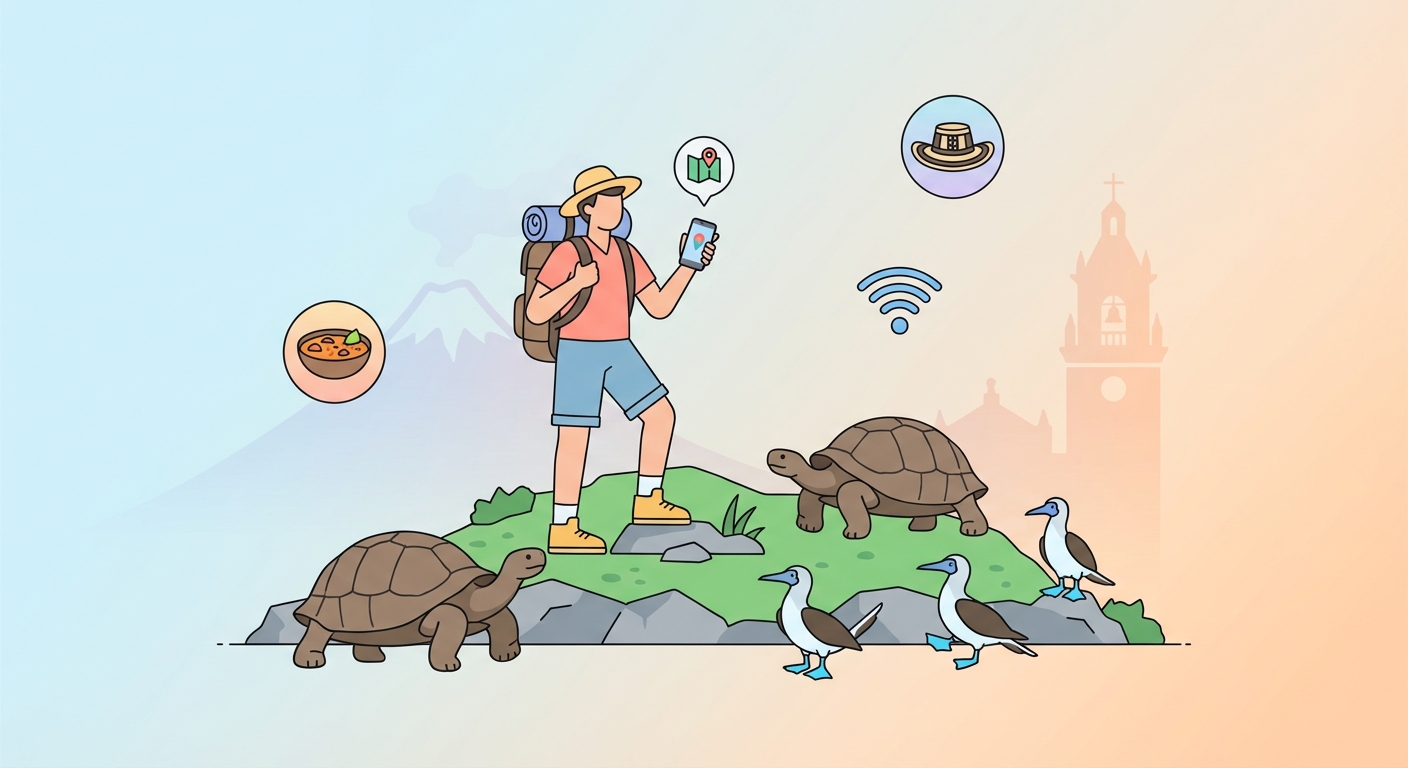
Wildlife enthusiasts should prioritise the Galápagos for its fearless marine iguanas and giant tortoises. Budget travellers can find affordable hostels and almuerzos (set lunches) in cities like Quito and Cuenca. Plan for altitude: Quito sits at 2,850 metres, so allow a day to acclimatise before hiking. The Galápagos requires separate park fees and a guided tour-book permits well in advance.

Attractions

Ecuador’s attractions cluster in distinct regions. Choose based on your interests and travel time.

  • Galápagos Islands - Unique wildlife above and below water. Snorkel with sea lions and spot blue-footed boobies. Independent travel is restricted; join a liveaboard or land-based cruise.
  • Quito - A UNESCO World Heritage site with well-preserved colonial architecture. Ride the TelefériQo for views of the Andes.
  • Amazon Rainforest - The Ecuadorian Amazon is accessible from Tena or Puerto Francisco de Orellana. Stay with a local guide for ethical wildlife spotting.
  • Otavalo Market - South America’s largest indigenous market, held every Saturday. Buy textiles and handicrafts, but bargain respectfully.
  • Cotopaxi National Park - A snow-capped volcano with short hikes to refuges. Check conditions before attempting the summit; it requires technical gear.

Skip the “Middle of the World” monument in Quito-it is a tourist trap. The true equator line is a few kilometres north, but the science is more interesting than the site.

Foods

Ecuadorian cuisine varies by region. These dishes are widely available and worth trying.

  • Ceviche - Coastal Ecuador serves ceviche with lime, cilantro, and a splash of orange juice. Unlike Peruvian versions, it is less spicy and often comes with popcorn or plantain chips.
  • Locro de papa - A creamy Andean potato soup with cheese and avocado. Perfect for high-altitude evenings.
  • Empanadas - Fried or baked turnovers filled with cheese, meat, or morcilla (blood sausage). Street stalls sell them hot.
  • Encocado - A coconut-based seafood stew from the coast. Shrimp or fish simmered in coconut milk and achiote.
  • Llapingachos - Crispy potato patties stuffed with cheese, served with peanut sauce and chorizo. A specialty of the central highlands.

Drink canelazo (spiced hot rum with naranjilla) in the Andes. Avoid tap water; always order bottled drinks without ice unless you are sure of the source.

Best Time to Visit

Ecuador does not have a single best season. Instead, timing depends on which region you visit.

The Galápagos Islands are best from June to September (dry, cooler water, more marine life) or December to January (warm water, seabird nesting). August is peak tourism-book early. The Amazon has two wetter periods: February to May and October to November. Rain is common year-round, but wildlife viewing is good in the drier months of June to September.

The Andes have a dry season from June to September and a wet season from October to May. Quito and Cuenca see frequent afternoon showers even in dry months. The Pacific coast is driest from June to December; January to May brings heavier rain and higher humidity. Regardless of when you go, pack for sudden changes. Ecuador’s altitude and ocean currents create microclimates that defy general patterns.

Packing

Ecuador’s varied geography demands versatile luggage. Focus on layering and weatherproof gear.

  • Lightweight, moisture-wicking clothing - Essential for the Amazon and coast. Quick-dry shirts and pants reduce sweat and discomfort.
  • Rain jacket or poncho - Afternoon downpours are common in the highlands and Amazon. A packable poncho also works as a blanket.
  • Sturdy hiking boots - Trails in Cotopaxi and the cloud forest can be muddy and rocky. Ankle support prevents injury.
  • Sun protection - Sunscreen, broad-brimmed hat, and UV-blocking sunglasses. The equatorial sun is intense even on overcast days.
  • Binoculars and camera - Wildlife viewing is best with good optics. Keep gear in a waterproof bag.
  • A universal power adapter - Ecuador uses 110V, 60Hz with Type A and B plugs, same as the United States.

Do not overpack. Laundry services are cheap and fast in most towns. Leave valuables at home; carry a money belt for markets and public transport.

Common Questions

The details worth knowing about your Ecuador eSIM

No, this eSIM is for Ecuador only. It does not include coverage in Peru or any other neighbouring country. If you need service in Peru, you would need a separate eSIM or plan for that destination.

Yes, you may have trouble. Claro and Movistar use B4 (AWS) as their primary LTE band. If your phone does not support B4, you might be limited to 3G or weaker 4G on other bands, especially outside major cities.

Coverage in the Galápagos is limited. You can expect 3G or 4G from Claro and CNT, but Movistar service is minimal. Speeds and reliability will be lower than on the mainland.

Your eSIM will connect to one of three operators: Claro Ecuador, Movistar Ecuador, or CNT. The network is selected automatically based on signal strength and availability in your location.

No, this eSIM does not require local ID or passport registration. It activates remotely and works immediately upon installation, unlike physical SIM cards that may require registration at a store in Ecuador.

Compare 1 GB / 7 days, 3 GB / 15 days and 10 GB or more / 30 days. Use the shorter profiles for lighter maps and messaging use, then compare the larger allowance for streaming, video calls or work apps.

The start rule is product-specific. Review the selected plan details before installing it so you know whether any action is required before arrival.

Save the QR code, manual installation details, APN guidance and the support instructions supplied with the selected plan.
24/7 Support

Stuck? Talk to a human.

Live chat and email are staffed the whole way through — before you fly and while you're abroad. Replies typically land in under 2 minutes.

Talk to us
Onetel customer support

Bundle Ecuador with other countries close by.