




🇵🇫 eSIM plans for French Polynesia

Starting at $2.79/day*
  • No data caps
  • 7-days valid
  • Fast, reliable connection
  • Skip the roaming bill
  • QR code emailed instantly
Get your unlimited data
How many days
More days, lower daily rate
7
How many eSIMs
More eSIMs, bigger discount
1
Install it now or once you're away. Nothing starts counting until you reach your destination and switch the eSIM on.

* The "as low as" figure is the lowest per-day rate, taken from the longest unlimited data plan on sale here.

Secure Checkout
Visa Mastercard PayPal Amex Diners JCB
French Polynesia eSIM travel illustration

Why buy from us?

Here's how Onetel stacks up against other options in French Polynesia.

Onetel
Local SIM card
Roaming
Uncapped data plans
Activates instantly
Your number stays the same
No surprise charges
No lock-in
24/7 support
🇵🇫

eSIM costs for French Polynesia

Prices shown in USD

1 GB for 7 days in French Polynesia costs $31.86 — about $4.55 a day on Vini or Vodafone Polynésie, with no roaming charge and no SIM to swap. In French Polynesia, 5G is live and median mobile download speed is 38.2 Mbps.

Duration Price Daily cost
1 day $19.34 $19.34/day
7 days $31.86 $4.55/day
15 days $79.86 $5.32/day
30 days $83.82 $2.79/day
🇵🇫

Which French Polynesia eSIM plan fits your trip?

Choose your French Polynesia eSIM by matching the allowance and validity period to your trip, then compare the selected product details with the local network, band and speed references already shown on this page.

Start with the length of your stay, then allow for navigation, messaging, streaming and work use. Each option below is a plan size that is currently available for this destination.

Short trip

1 GB / 7 days

Best for: A short visit with maps, messages and occasional browsing.

This option pairs the 1 GB allowance with a stated validity period of 7 days.

Usage tip: Save maps before longer journeys and use Wi-Fi for large downloads.

Two-week trip

3 GB / 15 days

Best for: A stay of around two weeks with regular navigation and messaging.

The 3 GB allowance remains available across a stated validity period of 15 days.

Usage tip: Keep automatic app updates and cloud backups on Wi-Fi.

Longer or higher use

10 GB or more / 30 days

Best for: A longer stay or more frequent streaming, video calls or work use.

The 10 GB or more / 30 days profile provides a larger data pool than the short-trip options on this page.

Usage tip: Compare the allowance with your normal phone usage and monitor it during the trip.

🇵🇫

Which networks you connect to in French Polynesia

Your eSIM roams onto French Polynesia's own operators. These are the networks and the frequencies they run — check your phone supports them before you travel.

Operator 4G / LTE bands 5G bands 5G
Vini B1, B3, B7, B20 n78 Yes
Vodafone Polynésie B1, B3, B7, B20 — No
38.2 Mbps
Median download
10.5 Mbps
Median upload

Source: Ookla Speedtest Global Index, July 2025

Coverage in French Polynesia

Extensive areas of the Marquesas Islands and Tuamotu Archipelago have no mobile service. Vini 5G coverage limited to central Papeete and Faaa as of 2025.

How to check mobile coverage in French Polynesia

The French Polynesia mobile network source is linked below as a public network reference. Check the places on your itinerary where the source offers local detail, then confirm the network information for the selected eSIM product. The operator table on this page provides the country-level reference, while the selected product details identify which network information applies to your plan.

Accommodation and daily stops

Check your accommodation and the places you expect to visit in French Polynesia. Indoor reception can differ from an outdoor map, so keep the property Wi-Fi details available as well.

Journeys between stops

Review the full route rather than checking only the arrival city. Save tickets, addresses and maps offline before longer road or rail journeys.

Borders and onward travel

Check the selected product scope for every country on your itinerary. Your French Polynesia plan and a regional plan may have different included destinations and validity periods.

Phone compatibility in French Polynesia

Compare your phone with 4G bands B1, B3, B7, B20 and 5G bands n78 in the existing French Polynesia network table. Support for more of the listed bands gives the phone more options when connecting, while the selected product, location and local network conditions determine the service available.

Set up the French Polynesia eSIM for your trip

Keep the QR code and installation instructions available offline, and complete each step according to the selected product's instructions.

When validity starts: Validity-start rules can differ by product. Check the selected plan details before installation and travel.

  1. Confirm that your phone is unlocked and supports eSIM before purchase.
  2. Save the QR code or manual installation details somewhere you can reach without mobile data.
  3. Use reliable Wi-Fi to install the profile at the time recommended in the product instructions.
  4. When you are ready to use it, select the travel eSIM for cellular data and apply the stated roaming and APN settings.
  5. Keep roaming disabled on your home line if you want to avoid using its travel data.
Network and coverage sources, checked 2026-10-10
French Polynesia travel guide

How to Enjoy French Polynesia

French Polynesia is best enjoyed at a relaxed pace. From the moment you arrive in Tahiti, allow yourself to adjust to island time. In Bora Bora, the main activity is simply being on or in the water. Snorkelling, paddleboarding, and sunset boat trips are the norm. French and Tahitian are the main languages, but English is spoken at resorts and tourist offices. Whether you stay in an overwater bungalow or a family-run pension, respect local customs: remove shoes before entering a home and never take coral or shells as souvenirs. With a single island-hopping flight between Papeete and Bora Bora, plan at least three nights per island to avoid losing days to transit. Tipping is not expected but is appreciated for exceptional service.

Top Attractions

Bora Bora Lagoon. The calm, turquoise lagoon is protected by a barrier reef. It is ideal for swimming, kayaking, and spotting stingrays. Boat tours often stop at shallow sandbanks where you can stand in knee-deep water.

  • Mount Otemanu. The extinct volcanic peak at Bora Bora’s centre. You cannot hike to the summit, but 4x4 tours take you to viewpoints on the lower slopes.
  • Rangiroa Atoll. Famous for the Tiputa Pass, where strong currents attract sharks, dolphins, and rays. Drift snorkelling or diving here is high-quality.
  • James Norman Hall's House. A historic home of the co-author of Mutiny on the Bounty, located on Tahiti’s north coast. It now serves as a small museum.
  • Faanui Bay. On Bora Bora’s main island, this bay contains remnants of World War II gun emplacements and a quiet beach.

Each site is best visited with a guide or as part of a small-group tour. Home to fragile ecosystems, French Polynesia's attractions reward slow, respectful exploration.

Must-Try Foods

Poisson Cru. A French Polynesian staple: raw, sushi-grade fish marinated in lime juice and coconut milk. It is served as a starter or main course. Local versions use tuna or mahi-mahi.

  • Ahi Ahi. A mild, white-fleshed fish often grilled or seared. It appears on most restaurant menus and is a safe choice for those new to Pacific seafood.
  • Tahitian Breadfruit. A starchy, potato-like fruit. It is roasted, boiled, or fried. Try it as a side dish or in fritters.
  • Fafaru. A fermented shrimp paste. It is an acquired taste and very strong. Only for adventurous eaters.
  • Tropical Fruits. Pineapple, papaya, mango, and coconut are abundant. Eat them fresh from market stalls rather than from resort buffets.

Raw fish is safe at reputable restaurants. Avoid reef fish like barracuda if you are pregnant or have dietary restrictions.

Best Time to Visit

The dry season from May to October is the most popular time to visit French Polynesia. During these months you will see blue skies, calm seas, and lower humidity. The water is clearest for snorkelling. November to April is the wet season, with higher rainfall and more wind. Despite the rain, temperatures remain warm (mid-20s to low-30s Celsius). December and February are the wettest months, but showers often pass quickly. If you want fewer crowds and lower prices, travel in November or April. Cyclones are rare but possible from November to March. For whale watching, July to October is best for humpback sightings near Moorea and Tahiti. Regardless of season, expect occasional mosquitoes, especially after rain.

Packing Essentials

High-SPF Sunscreen. Reef-safe, biodegradable sunscreen is required by law in French Polynesia. Bring enough for your entire stay; local shops sell it at a premium.

  • Water Shoes or Reef Booties. Essential for walking on coral rubble and rocky shorelines. Many beaches have sharp shell fragments.
  • Lightweight, Breathable Clothing. Quick-dry shorts, cotton shirts, and a light rain jacket. Bring a sarong or wrap for visiting villages and churches.
  • Snorkeling Gear. Bring your own mask and snorkel for a better fit. Fins are bulky but worthwhile for current-prone passes.
  • Waterproof Camera. A simple action cam or waterproof phone case lets you capture lagoon life without risking electronics.

Your uPhone eSIM will connect on Tahiti and Bora Bora, but coverage is limited on smaller islands. Download offline maps before you arrive.

Common Questions

The details worth knowing about your French Polynesia eSIM

The eSIM connects to Vini (4G/5G) and Vodafone Polynésie (4G only). Vini has 5G only in central Papeete and Faaa. Both networks share similar 4G bands, but large parts of the Marquesas Islands and Tuamotu Archipelago have no mobile service at all.

Both Vini and Vodafone use 4G bands B1, B3, B7, and B20. Most international phones support these bands. Phones lacking B20 (700 MHz) may get weaker signal in rural or indoor areas, since B20 provides better range.

No. The eSIM only works on the networks of French Polynesia (Vini and Vodafone Polynésie). It stops at the maritime borders. If you travel to the Cook Islands, Fiji, or other Pacific territories, you would need a separate eSIM for each country.

The eSIM data is not filtered or blocked. It connects to the local networks with standard roaming terms. Median download speed is 38.21 Mbps (Ookla, July 2025), but actual speed depends on your location and network congestion.

Coverage is absent across large areas of the Marquesas Islands and Tuamotu Archipelago. Vini 5G only reaches central Papeete and Faaa. On ferry routes between islands, expect no signal once away from populated coasts.

Compare 1 GB / 7 days, 3 GB / 15 days and 10 GB or more / 30 days. Use the shorter profiles for lighter maps and messaging use, then compare the larger allowance for streaming, video calls or work apps.

The start rule is product-specific. Review the selected plan details before installing it so you know whether any action is required before arrival.

Save the QR code, manual installation details, APN guidance and the support instructions supplied with the selected plan.
24/7 Support

Stuck? Talk to a human.

Live chat and email are staffed the whole way through — before you fly and while you're abroad. Replies typically land in under 2 minutes.

Talk to us
Onetel customer support

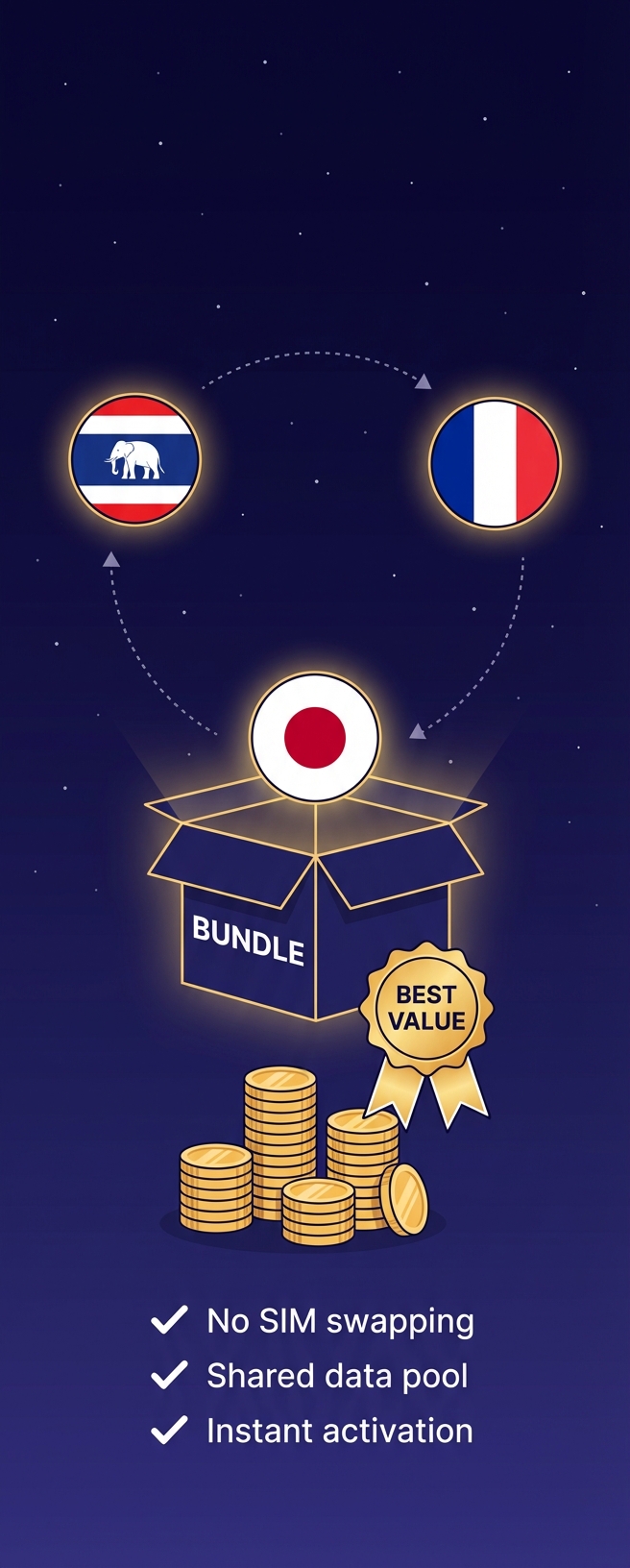
Bundle French Polynesia with other countries close by.

Bundle value illustration
📦
BUNDLE
Best Price
A single eSIM.
Several countries.