





🇵🇪 eSIM plans for Peru

Starting at $3.12/day*
  • No data caps
  • 7-days valid
  • Fast, reliable connection
  • Skip the roaming bill
  • QR code emailed instantly
Get your unlimited data
How many days
More days, lower daily rate
7
How many eSIMs
More eSIMs, bigger discount
1
Total
—
Get Peru eSIM
Install it now or once you're away. Nothing starts counting until you reach your destination and switch the eSIM on.

* The "as low as" figure is the lowest per-day rate, taken from the longest unlimited data plan on sale here.

Secure Checkout
Visa Mastercard PayPal Amex Diners JCB
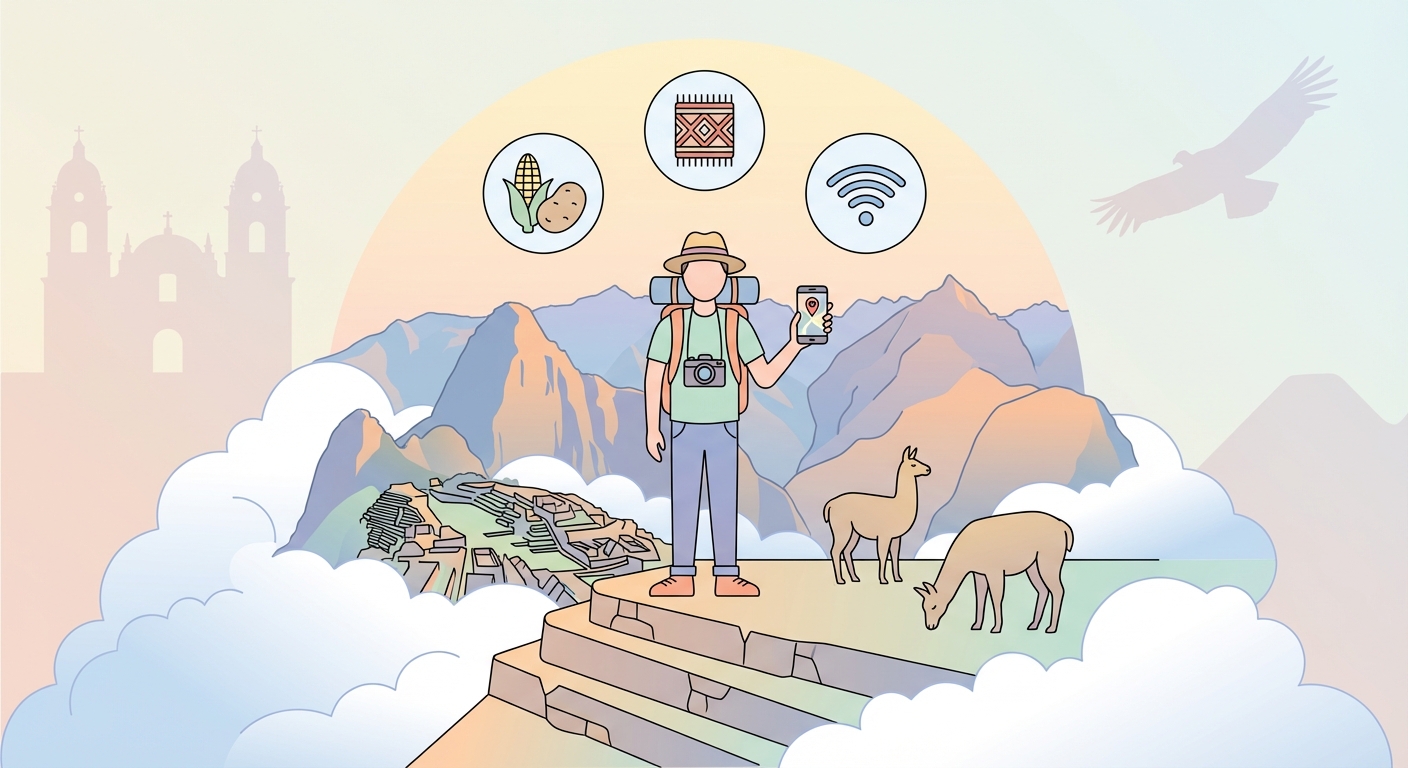
Peru eSIM travel illustration

Why buy from us?

Here's how Onetel stacks up against other options in Peru.

Onetel
Local SIM card
Roaming
Uncapped data plans
Activates instantly
Your number stays the same
No surprise charges
No lock-in
24/7 support
Latin America eSIM

Cover the Region with Latin America eSIM

Cover Peru and every neighboring country on one regional eSIM — no SIM swaps, no extra fees. Starting at $3.10.

View Latin America Plans
🇵🇪

eSIM costs for Peru

Prices shown in USD

7 days of unlimited data in Peru costs $34.40 — about $4.91 a day on Movistar, Claro or Entel, with no roaming charge and no SIM to swap. In Peru, 5G is live and median mobile download speed is 18.6 Mbps.

Duration Price Daily cost
1 day $6.22 $6.22/day
3 days $15.60 $5.20/day
5 days $25.00 $5.00/day
7 days $34.40 $4.91/day
10 days $37.56 $3.76/day
15 days $71.96 $4.80/day
30 days $93.60 $3.12/day
🇵🇪

Which Peru eSIM plan fits your trip?

Choose your Peru eSIM by matching the allowance and validity period to your trip, then compare the selected product details with the local network, band and speed references already shown on this page.

Start with the length of your stay, then allow for navigation, messaging, streaming and work use. Each option below is a plan size that is currently available for this destination.

Short trip

1 GB / 7 days

Best for: A short visit with maps, messages and occasional browsing.

This option pairs the 1 GB allowance with a stated validity period of 7 days.

Usage tip: Save maps before longer journeys and use Wi-Fi for large downloads.
Two-week trip

3 GB / 15 days

Best for: A stay of around two weeks with regular navigation and messaging.

The 3 GB allowance remains available across a stated validity period of 15 days.

Usage tip: Keep automatic app updates and cloud backups on Wi-Fi.

Longer or higher use

10 GB or more / 30 days

Best for: A longer stay or more frequent streaming, video calls or work use.

The 10 GB or more / 30 days profile provides a larger data pool than the short-trip options on this page.

Usage tip: Compare the allowance with your normal phone usage and monitor it during the trip.

🇵🇪

Which networks you connect to in Peru

Your eSIM roams onto Peru's own operators. These are the networks and the frequencies they run — check your phone supports them before you travel.

Operator 4G / LTE bands 5G bands 5G
Movistar B2, B4, B7, B28 n28, n78 Yes
Claro B2, B4, B7, B28 n28, n78 Yes
Entel B2, B4, B7, B28 n28, n78 Yes
Bitel B2, B4, B7, B28 — No
18.6 Mbps
Median download
8.1 Mbps
Median upload

Source: Ookla Speedtest Global Index, August 2026

Coverage in Peru

Large areas of the Amazon rainforest in Loreto, Ucayali, and Madre de Dios departments have no mobile service. B28 (700 MHz APT) is widely used for rural LTE coverage but is absent from many North American and European phone models.

How to check mobile coverage in Peru

The Peru mobile network source is linked below as a public network reference. Check the places on your itinerary where the source offers local detail, then confirm the network information for the selected eSIM product. The operator table on this page provides the country-level reference, while the selected product details identify which network information applies to your plan.

Accommodation and daily stops

Check your accommodation and the places you expect to visit in Peru. Indoor reception can differ from an outdoor map, so keep the property Wi-Fi details available as well.

Journeys between stops

Review the full route rather than checking only the arrival city. Save tickets, addresses and maps offline before longer road or rail journeys.

Borders and onward travel

Check the selected product scope for every country on your itinerary. Your Peru plan and a regional plan may have different included destinations and validity periods.

Phone compatibility in Peru

Compare your phone with 4G bands B2, B4, B7, B28 and 5G bands n28, n78 in the existing Peru network table. Support for more of the listed bands gives the phone more options when connecting, while the selected product, location and local network conditions determine the service available.

Set up the Peru eSIM for your trip

Keep the QR code and installation instructions available offline, and complete each step according to the selected product's instructions.

When validity starts: Validity-start rules can differ by product. Check the selected plan details before installation and travel.

  1. Confirm that your phone is unlocked and supports eSIM before purchase.
  2. Save the QR code or manual installation details somewhere you can reach without mobile data.
  3. Use reliable Wi-Fi to install the profile at the time recommended in the product instructions.
  4. When you are ready to use it, select the travel eSIM for cellular data and apply the stated roaming and APN settings.
  5. Keep roaming disabled on your home line if you want to avoid using its travel data.
Network and coverage sources, checked 2026-10-10
Peru travel guide

Ways to Enjoy Peru

From the high Andes to the Pacific coast, Peru offers a wide range of experiences. Machu Picchu remains the most famous destination, but the country's appeal extends far beyond that single site. The Amazon Rainforest provides wildlife and river journeys, while Lake Titicaca offers insight into traditional Andean communities. Whether you prefer hiking, cultural tours, or simply sampling local cuisine, plan your route carefully to avoid spending too much time in transit.

Stay in a mix of cities and rural lodges to appreciate Peru's contrasts. Cusco works well as a base for the Sacred Valley and Machu Picchu. Arequipa and the Colca Canyon suit those interested in colonial architecture and condor sightings. Peruvian food, recognised globally, can be enjoyed in markets and high-end restaurants alike. Choose activities that match your fitness level and altitude tolerance.

Key Attractions

Peru's major sites include Machu Picchu, the Sacred Valley, the Amazon Rainforest, Lake Titicaca, and the Nazca Lines. Each offers a distinct character.

  • Machu Picchu - The Incan citadel requires advance permits and a guided tour. Acclimatise in Cusco first.
  • Sacred Valley - Markets and ruins such as Ollantaytambo and Pisac are accessible by train or car. Allow two to three days.
  • Amazon Rainforest - Puerto Maldonado and Iquitos are common gateways. Choose a lodge with experienced naturalist guides.
  • Lake Titicaca - The Uros floating islands and Taquile Island offer insight into Aymara and Quechua traditions. Overnight homestays are available.
  • Nazca Lines - View by small plane over the desert. Motion sickness is common; consider taking precautions.

Each site sees many visitors. Book tickets and accommodation months ahead during peak season.

Foods Worth Trying

Peruvian cuisine blends Andean ingredients with Spanish and Asian influences. These dishes are widely available and representative of the country's culinary range.

  • Ceviche - Raw fish cured in citrus, served with onion and chilli. Lima's coastal restaurants serve it fresh. Avoid it from street stalls with uncertain refrigeration.
  • Lomo Saltado - Stir-fried beef with onions, tomatoes, and fries. A filling main course found in most eateries.
  • Causa Limeña - Cold mashed potato layered with tuna or chicken, avocado, and mayonnaise. Common as a starter.
  • Ají de Gallina - Shredded chicken in a creamy, mildly spicy yellow chilli sauce, often served with rice or boiled potatoes.
  • Quinoa Soup - Hearty Andean soup with quinoa, vegetables, and sometimes meat. Good for high-altitude recovery.

Each region has its own specialities. Ask locals for their recommendations rather than relying solely on tourist menus.

Best Time to Travel

Peru's climate varies greatly by region, so the best time depends on where you plan to go. The dry season from May to October is the most reliable period for the Andes and the Inca Trail. Machu Picchu sees clear mornings and afternoon clouds during these months. The Amazon is also drier from May to October, which makes trails more passable and wildlife easier to spot near riverbanks.

The coastal areas, including Lima, experience grey skies from May to October and brighter conditions from November to April. The northern coast, such as Mancora, stays warmer year-round. If you plan to visit multiple regions, aim for the shoulder months of April or November, when conditions are generally acceptable across the country. Each region has its own microclimate, so pack accordingly and check local forecasts before departure.

Packing Essentials

Peru's varied geography demands careful packing. Focus on versatility and layering.

  • Layers and warm clothing - High-altitude areas like Cusco and Machu Picchu can be cold, especially at night. A fleece jacket and thermal base layers help.
  • Sturdy hiking boots - Essential for the Inca Trail and uneven ruins. Break them in before your trip.
  • Sun protection - The Andean sun is intense. Bring a wide-brimmed hat, sunglasses, and high-SPF sunscreen.
  • Insect repellent - Necessary in the Amazon and lower elevations. Choose one with DEET or picaridin.
  • Water bottle and purification tablets - Tap water is not safe to drink. A reusable bottle with a filter or tablets reduces plastic use.
  • Your uPhone eSIM - Ensure your device works on local networks for maps and communication.

Pack light; laundry services are available in most towns. Leave valuables at your accommodation.

Common Questions

The details worth knowing about your Peru eSIM

The eSIM connects to Movistar, Claro, Entel and Bitel. All four support 4G on bands B2, B4, B7 and B28. Movistar, Claro and Entel also support 5G on n28 and n78; Bitel does not offer 5G.

Band 28 (700 MHz) is used by all four operators for rural LTE coverage. Many North American and European phone models do not support this band, so in remote areas like the Amazon rainforest your signal may drop significantly or disappear entirely.

No. This eSIM is for Peru only. Coverage ends at the border. If you cross into Ecuador, Colombia, Bolivia, Chile or Brazil, you will lose service unless you purchase a separate eSIM or roaming package for that country.

No. Data is not filtered, throttled or blocked beyond standard network management. You get full internet access without restrictions. However, median download speed is 18.62 Mbps, which is moderate and may feel slower in congested areas.

No. Visitors are not required to register a passport or ID to use an eSIM in Peru. The eSIM activates without providing personal identification, unlike some other countries that enforce mandatory SIM registration for tourists.

Compare 1 GB / 7 days, 3 GB / 15 days and 10 GB or more / 30 days. Use the shorter profiles for lighter maps and messaging use, then compare the larger allowance for streaming, video calls or work apps.

The start rule is product-specific. Review the selected plan details before installing it so you know whether any action is required before arrival.

Save the QR code, manual installation details, APN guidance and the support instructions supplied with the selected plan.
24/7 Support

Stuck? Talk to a human.

Live chat and email are staffed the whole way through — before you fly and while you're abroad. Replies typically land in under 2 minutes.

Talk to us
Onetel customer support